



The Bill of Lading (BL) is an important customs clearing document when importing/exporting to Nigeria. Here is why the BL is important and how to properly fill it out.
When exporting to Nigeria, there are several customs clearing documents you need to successfully import goods into Nigeria. The Bill of Lading is one such document.
What is a Bill of Lading?
A Bill of Lading (BL) is the primary document used for sea transport. It functions as a contract of carriage, transport goods receipt and a document of title affording ownership. It is a contract between the shipper, carrier and consignee stating what goods are being shipped, where the shipment is coming from and where it’s headed to.
The shipper – Is responsible for packing and preparing the shipment for transportation. This might be your supplier, or your own warehouse/manufacturer.
The carrier – Is the party that moves the cargo. So, this would be any shipping line, haulage company or airline that carries your cargo.
Consignee – Is the party designated to receive the shipment. Again, depending on what you’re shipping this could be your company, or a manufacturer who uses parts you’re shipping.
Notify party – The person designated on the BL as responsible for receiving the shipment and arranging for customs clearance. Can be the buyer, consignee, shipping agent, or any other entity.
The Bill of Lading is only issued after vessel departure from the Port of Loading and the customer has provided all the details. Details such as the shipper, consignee, notify party, commodity, weight, cargo description, etc. It also serves as a receipt, i.e., an acknowledgement that the goods have been loaded (not where the cargo is) and contains evidence for the terms of the contract of carriage.
What are the components of a Bill of Lading?
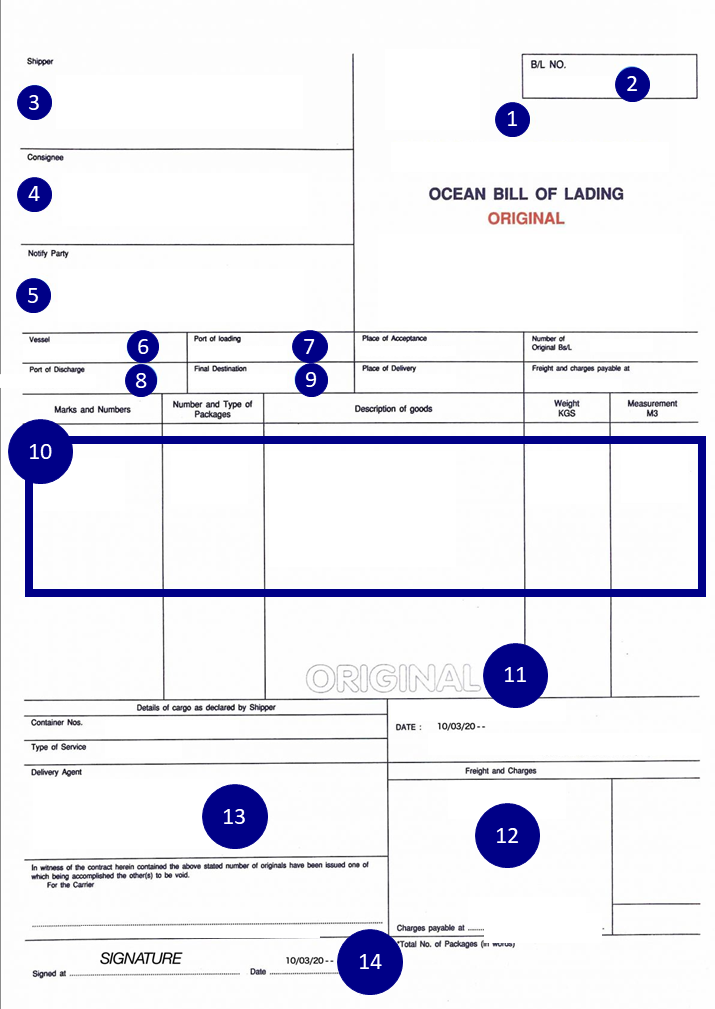
- Ship Line name // 2. B/L number // 3. Shipper - About exporters // 4. Consignee /About importers // 5. Notify Party // 6. Vessel name and Voyage Number // 7. Port of Loading // 8. Port of Discharge // 9. Place of Delivery // 10. Description of Cargos (Mark, Quantity, Weight, Number of containers, Packing form etc) // 11. Type of B/L // 12. Freight Payment Place Prepaid (Shipper payment) or Collect (Cnee payment) // 13. Information of the Destination Agent // 14. B/L issued date
Why is the Bill of Lading Important?
The Bill of Lading acts as the legal document of title which allows the person holding it to claim ownership of the cargo. This means that filling out your Bill of Lading accurately and completely is very important. The Bill of Lading also acts as a contract of carriage, it only details the responsibilities of the carrier as the party involved in the transportation of the cargo.
Types of Bills of Lading
- Original Bill of Lading: This is the BL the buyer/consignee needs to present to receive the order from the supplier/shipper.
- House bill of lading or Seaway Bill: The Seaway bill is another key document used in sea transport when the supplier/shipper decides to release ownership of the cargo to the buyer or Sea Waybill consignee immediately. This means that the cargo can be picked up by the Sea Waybill buyer/consignee without presenting a document of ownership. A Sea Waybill is proof of a contract of carriage and a transport goods receipt but does not give title to the goods.
- Negotiable and Non-Negotiable Bill of Lading
- Negotiable bill of lading: In this type of BL, clear instruction is provided to deliver the goods to anyone possessing the original copy of the BL, which signifies the title and control of the cargo. In this type of bill, the buyer/ receiver or their agent has to acquire and present an original copy of the BL at the discharge port. Without an original BL copy, the cargo will not be released.
- Non-negotiable bill: This type of BL fixes a specific consignee/name of the receiver to whom the cargo will be shipped and delivered. It, however, does not itself serve the owner of the goods. Under this bill, the assigned receiver/buyers can claim the cargo by confirming their identity.
- Electronic Bill of Lading:
With the modernization of the shipping industry, the bill of lading is also available as an electronic bill of lading to solve the issues occurring while using a paper bill of lading.
a.) The problems faced when using a paper bill of ladings are:
-
- The paper BL is printed which is costly and not environmentally friendly. In addition, the paper BL must be couriered, which is an additional cost.
- It takes the paper BL time to get to the receiver.
- Carriers are obligated to release the goods on the production of an original bill of lading, which will slow the process if not received in time.
- The paper bill can be forged, and delivery of goods against a forged bill of lading will lead to a huge loss.
b.) Advantages of Electronic Bill of Lading:
-
- As there is no printing involved, it saves paper cost as well as the cost involved in sending the paper to a different destination by courier.
- The electronic bill of lading can be transmitted instantaneously worldwide wherever an internet connection is available, enabling quick trade and ease of multiple ownership transfers during the cargo carriage.
- If any modifications are required in the bill, they can be made quickly and cost-effectively compared to the paper bill of lading.
- If the electronic bill of lading is drawn correctly, such as introducing audit trials, PIN, electronic signature etc., it will be difficult to commit fraud.
c.) Problems with the Electronic Bill of Lading
-
- It is possible to negotiate and transfer the possession of the paper bill as it is evidence of the title of the goods. However, this is not automatically the case with e-bill.
- If the electronic bill system is not secured, it can be hacked, and the details can be manipulated as per the hacker’s convenience, leading to fraud and loss of cargo.
- Implementation of an electronic bill system across the industry needs consent from all the stakeholders, which will take time.
Finally, the bill of lading is one of the documents required when applying for a Pre-Arrival Assessment Report (PAAR). The PAAR is processed through the Nigeria Single Window Trade Portal by your dealing bank. Once the Form M and PAAR have been processed, the dealer bank submits the BL, Form M, PAAR along with the SONCAP Certificate and other shipping documents to the Nigeria Customs Services (NCS) for customs clearance.
Importers can request for a SONCAP and/or Product Certificate from Cotecna, an Independent Accreditation Firm (IAF) appointed by the Standards Organisation of Nigeria (SON) to issue Certificates of Conformity for regulated imported products. With offices in over 100 countries, Cotecna can issue the mandatory certificates before shipping of products to avoid clearance delays upon arrival at Nigerian ports of entry.
To learn more about exporting to Nigeria or to get a free quote, please contact us.
About Cotecna
For over 50 years, we have been supporting agriculture, food and pharma, minerals and metals, and consumer products supply chains all over the world. We provide testing, inspection, and certification services to help our clients navigate evolving regulations, ensure product compliance, and support their sustainability journey.